The IACP model policy lists training, certification, awards, bite memos, recall memos, veterinary records, and items a supervisor designates.
Pennsylvania requires 16 hours of maintenance training a month for police canine teams, and each session needs a record someone can find later.
Pennsylvania keeps basic, maintenance, and evaluation records through the dog’s service plus at least five years.
For a K9 unit audit, police departments should be ready to produce five record sets: training logs, certification files, deployment records, handler records, and the supervisory review trail that shows problems were caught and fixed. Each needs a complete history, and all five should connect by dog, handler, and date.
Audits rarely go badly because a unit did no work. They go badly because the work was documented inconsistently, stored in too many places, or could not be verified quickly. When leadership, risk management, or an outside reviewer asks for records, the test is whether the unit can produce a complete history without a week of cleanup.
Checklist
- Training logs show date, objective, participants, conditions, result, and corrective action.
- Certifications show current status, evaluator, standard, and renewal history.
- Deployment records include mission type, location, outcome, and post-event review.
- Handler records include assignment history, credentialing, policy acknowledgements, and continuing education.
Training logs are the first record set
Auditors generally expect to see training logs that show frequency, objectives, conditions, participants, outcomes, and follow-up actions. If the logs are vague or inconsistent, the unit may have trouble proving that training was regular, scenario-based, and aligned with policy or certification expectations.
A reliable log should include the dog, handler, trainer or evaluator, location, drill type, conditions, duration, result, and notes. Media, GPS history, or attachments can strengthen the record, but the core value is structure and consistency.
Certification files must show status and support
The audit packet should make it easy to identify which certifications are current, when they were issued, when they expire, who evaluated them, and what standard governs each one. Supporting training history should be accessible, because an active certificate is stronger when the unit can also show the training cadence behind it.
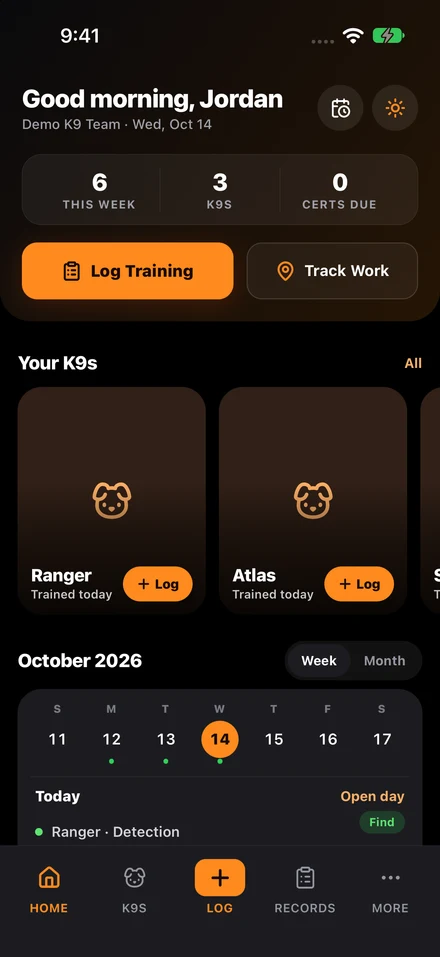
This is one reason departments move from spreadsheets to K9 software: the certification record and its supporting evidence stay linked instead of living in separate systems.
Deployment documentation matters as much as training
Audits often review whether field use aligns with documented readiness. Deployment logs should show date, time, location, mission type, personnel involved, result, and any attached after-action or incident documentation. If deployment history is partial or detached from the dog and handler record, leadership cannot confidently review trends or exceptions.
Well-maintained deployment logs also support policy review. They help answer whether certain use cases are increasing, whether outcomes differ by terrain or assignment type, and whether training priorities should change.
Handler records close the loop
Departments also need documentation on the human side of the program. That may include assignment history, credentialing, internal approvals, continuing education, policy acknowledgements, and role changes. If a handler is not current on required qualifications, that gap affects the readiness picture just as much as a dog certification issue.
Whatever software you use, a supervisor should be able to review dog records and handler records together. The complete guide to K9 unit management covers how those records connect.
Review logs are what prove the process is managed
A final record set that departments often overlook is the review trail. Supervisory check-ins, missing-record follow-ups, renewal reminders, and corrective actions show that someone acts on the records instead of only filing them. Those reviews can matter as much as the underlying logs because they demonstrate oversight.
The simplest audit checklist is this: can the department show what happened, who owned the next action, and whether the issue was resolved? If that answer is yes across training, certifications, deployments, and handler oversight, the audit conversation is usually much smoother.
Questions teams ask
What K9 records are most likely to be requested during an audit?
Training logs, certification files, deployment history, handler credentials, veterinary/health records, and supervisory review notes are the safest starting packet.
Why do review logs matter?
Review logs show that the unit actively manages quality instead of merely collecting forms. They also explain who owned missing items and when issues were corrected.
Sources cited in this guide
Continue reading
Continue with the complete guide to K9 unit management for the broader operating model, or see K9Codex, our K9 records software for how training records work in the app.