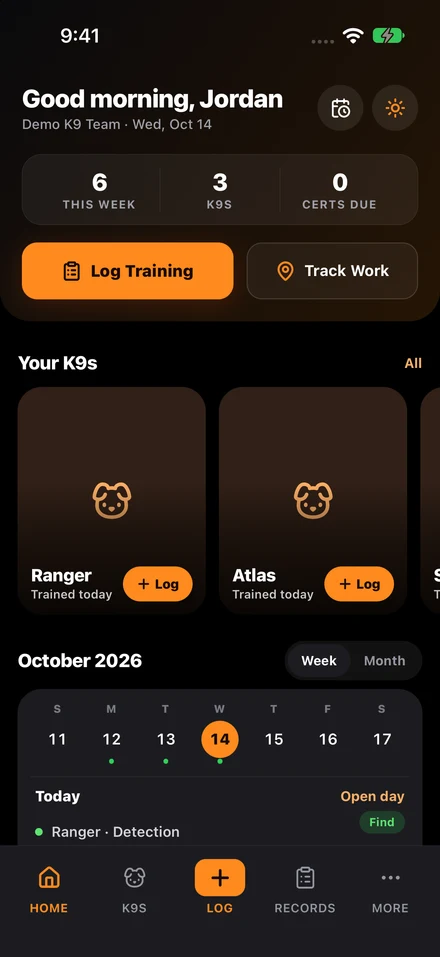
Pennsylvania requires 16 hours of maintenance training a month for police canine teams, and each session needs a record someone can find later.
Washington certifies the handler and dog as a team; it stays valid for 24 months if the team and its function do not change.
Pennsylvania keeps basic, maintenance, and evaluation records through the dog’s service plus at least five years.
K9 unit management means keeping every dog and handler trained, certified, and ready to deploy, and being able to prove it when someone asks. It stops being simple once a team grows past one handler, one dog, and one filing cabinet: training logs live in one place, certification dates in another, deployment notes in a notebook, and command staff still expect an answer in minutes when they ask whether a dog is current, who signed off on the last track, or which records support a use-of-force review.
That is why K9 programs eventually move off paper binders and ad hoc spreadsheets. Generic admin software does not fix it. What helps is a system built around how K9 work runs: dog profiles, handler assignments, scenario-based training logs, renewal windows, deployment history, and reports that hold up when leadership, auditors, insurance carriers, or a court reviews them.
This guide lays out the operational model. It explains which records matter, how those records connect, where teams usually create compliance gaps, and what a modern workflow looks like when the process is deliberate instead of improvised.
Checklist
- Dog profile, handler assignment, and active duty status are visible in one view.
- Each training log captures objective, location, conditions, evaluator, outcome, and follow-up.
- Certification records include issue date, expiration date, evaluator, standard, owner, and supporting training evidence.
- Deployment events connect back to dog, handler, mission type, and review notes.
- Supervisory reviews catch missing fields, overdue renewals, and unresolved corrective actions.
Start with the operating record, not the software
The strongest K9 programs do not begin by shopping for features. They begin by defining the operating record that must exist for every dog and every handler. That record usually includes the dog profile, current assignment, training cycle, certifications, evaluator history, medical record touchpoints, deployment events, equipment notes, and any policy-driven approvals that shape readiness.
Once that record is defined, the workflow becomes easier to standardize. Every session should answer the same basic questions: who trained, which dog participated, what objective was being tested, what conditions mattered, what was the result, and what follow-up is required. When those fields stay consistent, supervisors can compare performance over time and generate reliable summaries instead of reconstructing history after the fact.
Programs that skip this step end up with plenty of notes but no dependable timeline, dates with nobody assigned to the next action, and reports that only exist after hours of cleanup. Decide what must be true in the record before anyone thinks about layout or automation.
- Keep one authoritative record for each dog, handler, certification, and deployment event
- Standardize session fields so training records can be compared across trainers and time periods
- Assign ownership for renewals, reviews, and exception handling before problems occur
Training documentation should mirror real field work
Working-dog programs rarely fail because handlers forgot to train. They fail because records do not show what happened with enough structure to prove consistency. A useful training log captures the mission type or drill objective, location, duration, conditions, aids used, decoys or evaluators involved, response quality, corrective action, and final outcome. If the program also tracks GPS routes, media, or weather, that context strengthens later reviews.
The log should also show progression. Repeated drills without a visible pattern make it hard to defend readiness decisions. A supervisor should be able to see whether odor work is improving, whether tracking performance drops in wet conditions, or whether handler substitutions are affecting outcomes. That requires consistent fields and searchable history, not a folder full of PDFs with different naming conventions.
This is where many teams decide they need better tools. A notebook is quick in the field but weak for oversight. A spreadsheet is better for totals but cannot enforce structure. Dedicated K9 management software helps because it requires the same fields every time, so training data can be compared and trusted.
Certifications need lifecycle tracking, not a folder
A certificate scanned into a folder is not a certification system. Teams need to know what type of certification is active, when it expires, who evaluated it, what standards apply, how renewal windows are calculated, and what training or documentation is required before re-test. That is a lifecycle problem, not a storage problem.
The practical workflow is straightforward. Each certification record should carry a status, issue date, expiration date, warning window, responsible owner, and links to the supporting training history that led into the assessment. If the dog or handler changes assignment, the system should reflect that context as well. Renewal reminders must reach the right person early enough to schedule training and evaluation, instead of alerting leadership once the deadline is already urgent.
Programs that treat certifications as living records are easier to manage and easier to defend. Programs that treat them as static uploads often discover missed deadlines only when an audit, deployment, or public-records request forces a review.
Deployment history should be searchable and reviewable
Deployment tracking matters because field work is often the moment where training, policy, and documentation meet. If a dog is used in patrol support, detection, search, article recovery, or suspect tracking, the record should show who deployed, where it happened, what the mission objective was, what conditions affected the outcome, and what documentation was attached afterward.
The most effective deployment logs are tied back to the dog profile and handler record automatically. That lets supervisors review all events for a single team or compare events across the whole unit. It also makes post-incident reporting less chaotic because the timeline already exists in a consistent format.
Searchable deployment history also improves training. Supervisors can compare field conditions with training conditions, spot gaps as they appear, and decide whether certain scenarios need more repetitions. Deployment records are feedback for readiness, not only paperwork for a legal review.
Handler oversight is part of the system
K9 program documentation is often described as dog-centric, but handler oversight matters just as much. Teams need clear records for assignment changes, credentialing, continuing education, performance reviews, equipment sign-outs, and scheduling constraints. If a handler is not current on a required course or internal approval, that should be visible before an operational problem appears.
A strong program also separates roles cleanly. Handlers should be able to create and update the records they own. Supervisors should be able to review, approve, and export. Command staff should have visibility without unrestricted editing. That role structure protects data quality and produces a cleaner audit trail.
This is where K9 software does better than generic team tools: it keeps dog records and handler records together, so teams do not have to improvise access rules across unrelated systems.
Compliance becomes manageable when review loops are scheduled
Most compliance failures in K9 programs are not dramatic. They are small gaps that compound: a late certification reminder, a missing evaluator name, a deployment note that never got attached, a veterinary update sitting in email, or a monthly review that slipped during a busy operational period. Teams reduce these failures by scheduling recurring review loops.
At minimum, supervisors should run a weekly readiness review, a monthly certification and documentation review, and a quarterly comparison of policy against records. The point is to catch incomplete records while they are still easy to fix. When the system shows expiring items, missing fields, and overdue reviews in one place, those check-ins become routine quality control instead of cleanup days.
That is also why software selection matters. If the platform cannot surface gaps quickly, the team ends up doing detective work every review cycle. A better process reduces the review burden because the workflow itself prevents common omissions.
What K9 unit management software should do
When buyers evaluate software, they should ignore vague AI claims and generic CRM language. The useful questions are operational. Can the system log training sessions in a structured format? Can it track multiple certifications per dog? Can it connect handlers, dogs, training logs, and deployments in one timeline? Can it export reports without manual cleanup? Can it show who changed a record and when?
It should also work on a phone, support role-based access, keep an audit trail, and hold the attachments that matter in the field. If a team has to run half the workflow outside the product, the product is not solving the problem. The right system cuts down the number of places where records can drift apart.
Teams comparing vendors should review the live workflow instead of a feature checklist. Ask to see how a session is created, how a certification is renewed, how a deployment is logged, how a supervisor reviews readiness, and how a report is exported. Those demonstrations reveal whether the product was built for real K9 operations or merely adapted from a general recordkeeping tool.
Where to start
Most teams arrive with one narrow problem: an expiring certification, an audit request, a deployment log that will not reconcile, or a software comparison that is going nowhere. The best documentation system is the one your team will keep up every day, so start wherever the pain is.
Each K9 article in the resource library covers one of those problems in detail and links back here for the full operating model. Start with that article if the issue is urgent. Start with this guide if you are designing the whole system.
If you are evaluating software now, use this guide as the checklist. K9Codex, our K9 training management software, is a free download for iPhone, Mac, and Windows; a workspace needs a subscription ($10 per seat a month on the web, or an App Store subscription) or an invitation from your team. Hold it, or any other product, against this checklist and ask whether your team would be more consistent six months from now.
Questions teams ask
What is the first K9 record a team should standardize?
Start with the operating record: dog profile, handler assignment, training history, certifications, deployments, and supervisory review status. Software choices become much clearer once that record is defined.
How often should K9 supervisors review documentation?
A weekly readiness review and monthly certification/documentation review catch most gaps before they become audit problems. High-risk teams can tighten that cadence around deployments or renewal windows.