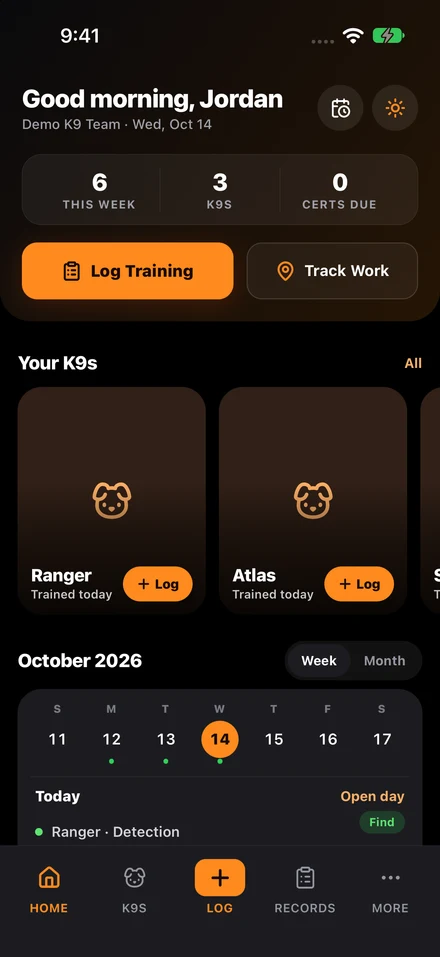
Pennsylvania requires 16 hours of maintenance training a month for police canine teams, and each session needs a record someone can find later.
After two consecutive missed monthly training periods, Pennsylvania requires an evaluation before the team works again.
Pennsylvania keeps basic, maintenance, and evaluation records through the dog’s service plus at least five years.
The most common compliance gaps in police K9 programs are missed renewal windows, training logs too vague to defend, deployment records cut off from the dog and handler history, no scheduled supervisory review, and forms that no longer match current policy. Each one is ordinary, and each one is fixable.
Compliance problems in police K9 programs usually grow out of ordinary friction. A renewal reminder arrives late, a deployment record stays unfinished, or a supervisor assumes someone else handled the follow-up. None of those gaps feels major in isolation, but together they weaken the record of the entire program.
The practical fix is not more policy language. It is a workflow that makes gaps visible while they are still easy to correct.
Checklist
- Review renewal windows and owners before deadlines become urgent.
- Reject vague training logs that do not include objective, conditions, result, and follow-up.
- Connect deployments to dog, handler, and training history.
- Compare policy changes against actual forms and required fields.
Missed or poorly managed renewal windows
One of the most common gaps is treating expiration dates as information instead of as action plans. Teams know the date, but they do not assign ownership, schedule preparation, or connect the renewal to the training evidence that supports readiness.
A visible warning window and accountable owner solve most of this problem before it becomes urgent.
Training logs that are too vague to defend
Another frequent issue is low-detail training documentation. Logs that say “worked odor” or “did tracking” may reflect real activity, but they do not support strong supervisory review. Without objective, conditions, result, and follow-up, the record is too thin to be useful later.
Thin records are especially risky because they look complete until someone tries to rely on them.
Deployment records disconnected from the rest of the unit history
Departments often document deployments, but the records are not linked to dog profiles, handler status, or training context. That fragmentation makes it hard to review whether operational use matched the team’s documented readiness at the time.
A stronger workflow links every deployment to the dog, the handler, and recent training, following the record model in the complete guide to K9 unit management. Reviewers can then see the team’s readiness at the time of the event without piecing it together.
No scheduled supervisory quality control
Many compliance issues persist simply because nobody reviews the data on a regular cadence. Weekly or monthly checks for missing fields, upcoming expirations, and unresolved follow-ups catch a large share of problems early.
Without that review rhythm, the unit finds out about gaps only when an outside request forces a scramble.
Policy and records drifting apart
A final gap appears when written policy changes but the forms and workflows do not. New requirements get announced, but the team still logs work the old way. That mismatch creates inconsistency even among conscientious handlers.
Periodic policy-to-record reviews are what keep the documentation system aligned with the actual operating standard.
Questions teams ask
What is the most common K9 compliance gap?
The most common gap is unclear ownership: dates are known, but nobody owns the next action, packet review, or follow-up.
How do teams prevent policy drift?
Run a scheduled policy-to-record review. When policy changes, update forms, required fields, dashboards, and review checklists at the same time.
Sources cited in this guide
Continue reading
Continue with the complete guide to K9 unit management for the broader operating model, or see K9Codex, our K9 training software for how training records work in the app.