
Pet grooming software should schedule from the pet: breed, size, and coat decide how long a groom takes. Boarding and daycare software has to track capacity by run and by day, and check vaccines before a stay is confirmed. Generic booking tools usually do neither.
Pet businesses end up comparing those generic tools with industry suites priced by plan, location, van, team member, messages, or a mix. We build software for animal operations, including K9Codex for police and professional working-dog teams, and this is the checklist we would want every groomer and kennel owner to have before signing up for anything, including ours.
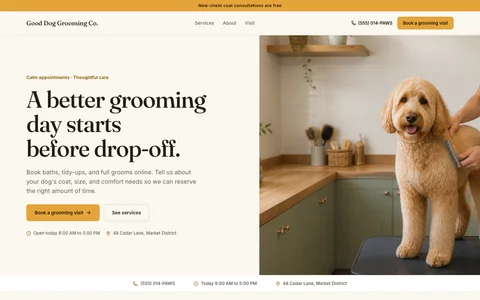 Need a site now?Build the grooming template free$0 to build and preview. Publish with booking requests, hosting, and SSL for $20 a month. New domain registration is separate.Need deeper booking?Compare the pet-aware workflowCompare custom scheduling, pet records, and reminders against your operational needs.
Checklist
- Run one grooming appointment, boarding stay, or daycare visit from request through completion.
- Try an overlapping reservation and a cancelled booking; check that availability and balances recover correctly.
- Verify what staff can see and edit using separate accounts, including pet notes and owner contact details.
- Export a sample pet record and calculate the full twelve-month cost using your actual staffing and usage.
Choose the system for the work you book most
A grooming appointment, a three-night boarding stay, and a daycare package consume different resources. Start with the workflow that earns most of your revenue, then test the other services using the same pet and owner. The following are evaluation scenarios, not claims that every product includes these features.
- Grooming salon: try two pets with different coat and service requirements. Check appointment duration, groomer availability, notes, and the handoff at pickup.
- Mobile groomer: place two appointments in different neighborhoods and inspect travel time, van assignment, arrival windows, and route changes.
- Boarding kennel: request overlapping stays for the final available run. Check capacity, check-in and checkout rules, and how staff review required documents.
- Dog daycare: redeem a package visit, cancel it, and check the remaining balance. Confirm daily capacity and how an owner gets an update.
- Website and inquiries only: a website with service information and a request form may be sufficient if staff already manage the schedule elsewhere.
Grooming scheduling depends on the dog
A common grooming scheduling failure is a full groom on a matted doodle booked into a slot sized for a bath and brush. Generic booking tools make this easy because they ask which service, never which dog.
Grooming software should set price and appointment length from the animal: breed, size, coat condition, and temperament. If the tool you are testing cannot give a schnauzer and a samoyed different amounts of calendar time, it is a generic appointment tool with a pet theme.
The pet record is the asset
The client list of a grooming or boarding business is not the owner’s phone number. It is the accumulated knowledge of the animal: vaccine dates, behavior flags, coat notes, photos, which dryer a dog tolerates, what happened last visit. On paper cards and in heads, that asset walks out the door with staff turnover.
Whatever software you choose, the pet profile should hold that history and you should be able to export all of it. Exportability varies by provider, so it is one of the first questions to ask a sales rep, not the last.
Boarding is a capacity problem first
A kennel is a small hotel with residents who cannot fill out forms. The core system is capacity: runs and suites tracked per night, daycare headcount per day, waitlists for the weeks that always fill, and no way for two dogs to hold one run. Whiteboards do this until the first holiday week, and then they do not.
Vaccine enforcement belongs at booking, not at drop-off. Software should check expiry dates against the stay and flag a lapsing bordetella before the reservation is confirmed, because catching it at the front desk with a lobby full of dogs is a policy failure you paid software to prevent.
- Capacity by run and by day, with waitlists, not a shared calendar
- Vaccine expiry checked automatically against stay dates
- Feeding and medication schedules staff can check off from a phone
- Owner photo updates that take seconds from the floor
Daycare runs on memberships and habits
Daycare revenue is repeat revenue: punch cards, monthly memberships, and the habit of Tuesday and Thursday drop-offs. Software should track packages automatically, warn when one is nearly used up, and make rebooking quick, because a membership that lapses without anyone noticing is a few hundred dollars gone.
Report cards and photo updates matter more than they look. Owners forward them, post them, and point to them when they decide whether the monthly fee is worth it. A system that lets staff send an update from the play floor in thirty seconds helps keep those members.
Compare pricing at your real volume
For a concrete comparison, MoeGo’s mobile-grooming pricing checked on September 16, 2026 lists Basic at $49/month, Growth at $99/month per van, and Ultimate at $159/month per van. These are mobile-grooming prices, not a quote for a boarding or daycare business. Check the linked provider page for your care type and plan.
Any variable fee deserves a line in the comparison, whether it is per appointment, location, team member, message, or marketplace client. Flat pricing can be cheaper for some small businesses, but the only reliable answer comes from running your real volume against every tier and add-on.
- Write down the number of staff, locations, vans, and monthly messages before comparing plans.
- Add processing, migration, hardware, extra messages, and any marketplace fees to the subscription total.
- Ask for a sample export of pets, owners, appointments, and notes before deciding how easy it will be to leave.
- Compare the same twelve-month period and confirm the cancellation and renewal terms.
What custom pet software costs with us
Our grooming software example scopes are $350 to $850 setup and $35 to $45 per month. Boarding and daycare examples are $450 to $1,000 setup and $45 to $60 per month. These are custom project planning ranges: pet profiles, scheduling rules, reminders, capacity, and integrations must be specified in the written quote.
If you only need a public website, try the grooming template: free to build and preview, then $20/month to publish with hosting, SSL, and booking requests. This site collects inquiries for your team to confirm; it is not a kennel capacity system, vaccine-validation engine, or payment processor. The live preview uses example business content and never sends a request.