Washington certifies the handler and dog as a team; it stays valid for 24 months if the team and its function do not change.
Pennsylvania requires an annual evaluation of each police canine team.
Pennsylvania requires 16 hours of maintenance training a month for police canine teams, and each session needs a record someone can find later.
A K9 handler credentialing system is a list of every credential that affects a handler’s assignment, each stored with the same fields (status, dates, owner, supporting document, review note), linked to the dogs that handler works, and reviewed monthly. It does not need special software to start, but it does need to be current and tied to assignment decisions.
Many K9 programs track dog certifications carefully but manage handler credentialing informally. That gap becomes a real risk once a team has to prove assignment eligibility, continuing education, or approval history during a review.
Checklist
- List every handler credential, approval, and policy acknowledgement that affects assignment.
- Use consistent status, issue date, expiration date, owner, document, and review-note fields.
- Tie handler status to dog assignments and supervisor reviews.
- Keep the workflow simple enough that a new supervisor can continue it.
Define which credentials affect readiness
Start by listing every handler-level credential, approval, or training requirement that affects field assignment. That can include internal approvals, course completions, external credentials, annual refreshers, or policy acknowledgements. If it affects whether someone should work a dog or perform a role, it belongs in the system.
That list becomes the rule set for the record. Without it, teams tend to track only the items that are top of mind this month.
Use the same fields for every credential
Each handler credential should carry a status, issue date, expiration date if applicable, owner, supporting document, and review note. The more standardized the fields are, the easier it is for supervisors to review the whole team quickly.
Consistent fields are what turn credentialing from a spreadsheet chore into something supervisors can use.
Tie credential status to assignments and reviews
Credentialing matters only if it affects operations. A supervisor looking at a handler assignment should be able to confirm whether the handler is current on the relevant requirements. If that check lives in a separate system, mistakes become more likely.
Keep handler status and dog readiness where a supervisor can see them side by side. The complete guide to K9 unit management explains how the two record types connect.
Create a recurring review loop
Credentialing systems stay clean when supervisors review upcoming expirations and missing documentation on a regular cadence. Monthly is enough for most teams, with extra attention on high-impact credentials that affect near-term assignments.
The review should answer three questions: what is expiring, what is missing, and who owns the next action. If the system cannot answer those quickly, it is not organized well enough yet.
Keep the process simple enough to survive turnover
A credentialing workflow that depends on one highly organized admin usually breaks when that person leaves. The process should be simple enough that another supervisor can step in, understand the fields, and continue the review without special knowledge.
A plain process that anyone can pick up beats an elaborate one that depends on a single person.
Questions teams ask
What counts as a handler credential?
Any training, approval, certification, policy acknowledgement, or continuing education item that affects whether a handler should work a dog or perform a field role.
Should dog readiness and handler readiness be separate?
They can be separate record types, but supervisors need to review them together because either side can affect deployment readiness.
Sources cited in this guide
Continue reading
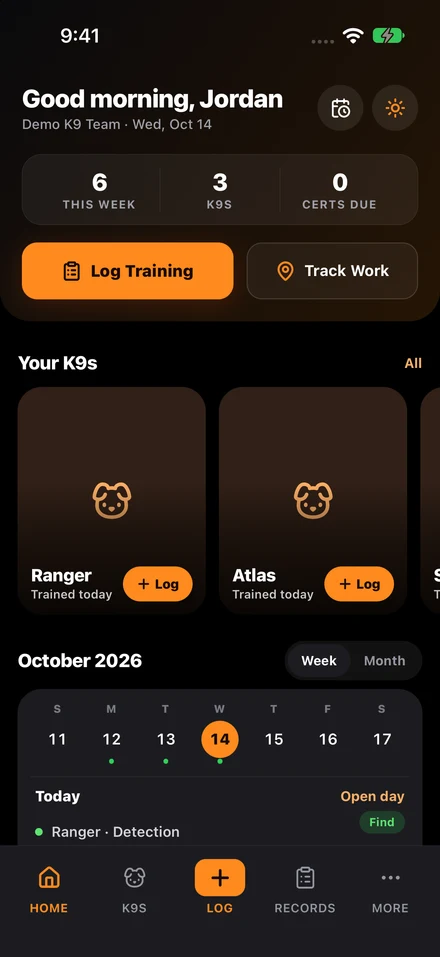
Continue with the complete guide to K9 unit management for the broader operating model, or see K9Codex, our K9 training software for how training records work in the app.