Start renewal planning early enough to book an evaluator and fit in any remedial training.
Confirm the date, review the packet, and make sure one person owns the renewal.
Washington certifies the handler and dog as a team; it stays valid for 24 months if the team and its function do not change.
To track police K9 certification expiration dates, keep each certification as its own record with an issue date, an expiration date, and one owner, set alerts at 90, 30, and 7 days out, and review everything expiring in the next 120 days once a week. That is the whole system; the rest of this article is how to run it.
Units rarely miss renewals because nobody cares. They miss them because the dates live in too many places (a spreadsheet, the certificate itself, a handler’s calendar) and nobody owns the renewal from start to finish. One record, one owner, and one warning window fix most of that.
Checklist
- Record certification type, evaluator, standard, issue date, expiration date, and owner.
- Flag renewals at 90, 30, and 7 days before expiration.
- Attach recent training history to renewal readiness reviews.
- Mark team-composition changes that may affect certification validity.
Store each certification as a live record
Each dog certification should have its own record with the certification type, issue date, expiration date, evaluator, governing standard, responsible owner, and status. If the handler assignment changes, that context should be visible too. This sounds basic, but it is where many units fail. They store a PDF instead of maintaining a record that can be sorted, filtered, and reviewed.
Once the certification is a live record, supervisors can sort by upcoming expiration, filter by certification type, and assign follow-up tasks without reconstructing the data every month.
Set warning windows ahead of the expiration date
Teams should never rely on the expiration date alone. Renewal windows need time for scheduling, make-up training, evaluator coordination, and paperwork review. A practical rule is to set at least two alerts: one early planning alert and one urgent action alert.
For example, a 90-day alert might tell supervisors to confirm availability and review readiness history. A 30-day alert can force the final renewal schedule. That structure reduces the chance that a missed email or vacation period turns into a compliance problem.
- 90 days out: confirm evaluator, training plan, and scheduling constraints
- 30 days out: finalize renewal event and review missing documentation
- 7 days out: confirm the packet is complete and the event is still on track
Tie renewal tracking back to training history
A date by itself does not tell you whether the dog is ready to renew. The certification record should connect to recent training logs, remediation notes, and any scenario-specific weaknesses that need attention before testing. That lets supervisors make earlier decisions instead of learning during the evaluation that a gap was visible all along.
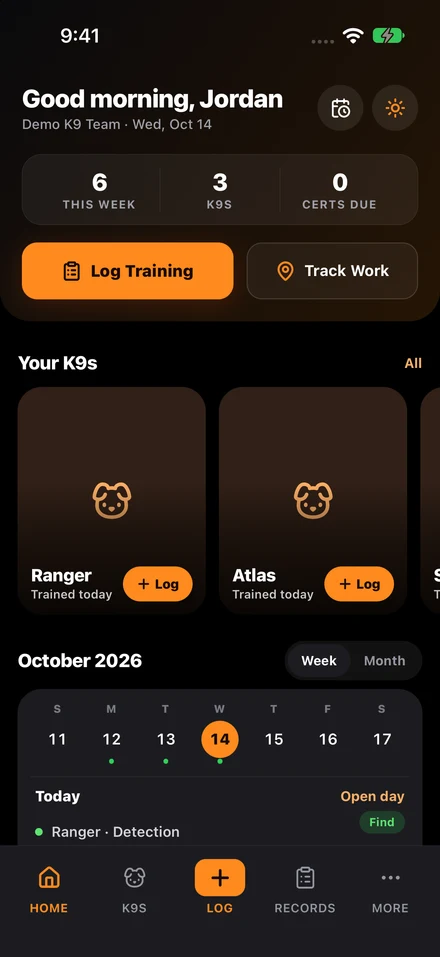
If you are building this process now, use the complete guide to K9 unit management as the checklist. In K9Codex, certification dates sit on the same dog record as the training logs, so the renewal and the evidence behind it stay together.
Assign one owner for every renewal
Shared responsibility usually means unclear responsibility. Every certification renewal needs one accountable owner even if multiple people contribute to the prep. That owner should know who schedules the evaluator, who reviews the records packet, who confirms the handler is available, and who uploads the final outcome.
A clean ownership model also improves audit response. When leadership asks why a renewal is at risk, the answer should come from one person with a current status view, not from a chain of forwarded messages.
Review upcoming expirations every week
Certification tracking works best as a weekly discipline, not a once-a-quarter scramble. Supervisors should review all items expiring in the next 120 days, check whether readiness evidence exists, and flag any missing documentation immediately.
That routine is exactly what dedicated software is meant to support. In a spreadsheet, the review still depends on manual sorting and disciplined editing. In software built for K9 operations, the dashboard surfaces the deadlines automatically and keeps the history attached to the record.
Questions teams ask
Is a scanned certificate enough for certification tracking?
No. A scan proves a document exists, but teams still need status, expiration, owner, evaluator, standard, and supporting training evidence in searchable fields.
Who should own a certification renewal?
One person should own the renewal status even when several people help with scheduling, training, and packet prep. Shared ownership is where deadlines usually drift.
Sources cited in this guide
Continue reading
Continue with the complete guide to K9 unit management for the broader operating model, or see K9Codex, our K9 training software for how training records work in the app.