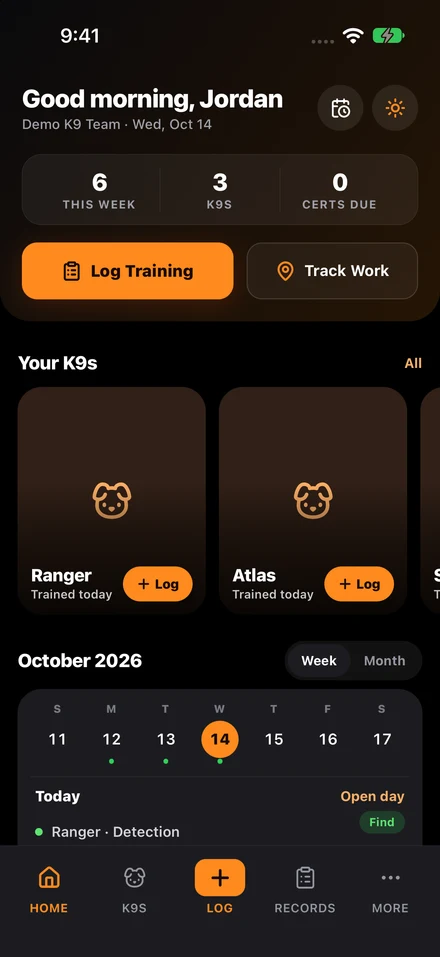
Private kennels standardize training documentation with three habits: one session template every trainer uses, a separate client-facing summary written from that record, and a weekly review of the logs. That keeps notes comparable across trainers and makes client updates quick to send.
Private kennels often hit the same documentation wall as police K9 units, just in a different operating environment. One trainer keeps detailed notes, another writes only outcomes, a manager needs a client-ready summary, and nobody wants to spend Friday rebuilding a week of work into something professional enough to send.
Standardization does not mean turning trainers into clerks. It means choosing a format that captures the essential operational details every time so the kennel can manage quality, communicate with clients, and track readiness consistently.
Checklist
- Use one session template across all trainers and programs.
- Separate internal correction notes from client-facing progress summaries.
- Track milestones, holds, and graduation readiness as dated records.
- Review missing fields and terminology every week.
Start with a shared session template
The simplest improvement is a shared template for every session. The kennel should decide which fields are mandatory across all programs: trainer, dog, date, objective, environment, duration, result, follow-up action, and any owner-facing note. Those fields should stay fixed even when program types vary.
A fixed structure lets the kennel compare dogs across trainers, detect stalled progress, and build client reports without asking everyone to rewrite their notes in the same voice.
Separate internal notes from client-facing summaries
Many private teams struggle because the same note is expected to do two jobs. Internal notes need candor, correction details, and training nuance. Client updates need clarity and direction. The easiest solution is to capture the internal record first and then generate a summary from the same source.
That way the kennel keeps a candid operational history without sending clients raw shorthand that was never written for them in the first place.
Use the same documentation logic for certifications and milestones
Even if a kennel does not run police-style certifications, it still has milestones that matter: board-and-train goals, readiness checks, evaluator sessions, veterinary holds, and graduation benchmarks. Those events should be documented with dates, owners, and status so nothing depends on memory.
Kennels that grow usually move these records into K9 training software so sessions, milestones, and trainer accountability sit in one place. The complete guide to K9 unit management describes the same record model for larger programs.
Review consistency every week
Standardization fails quietly when nobody reviews the records. Kennel leadership should sample logs each week for missing fields, vague outcomes, and inconsistent terms. Those reviews are how the business keeps quality consistent across trainers.
Weekly review also improves onboarding. New trainers learn the documentation standard faster when examples and corrections happen in real time instead of after a customer complaint or a missed handoff.
Better records help with renewals and referrals
Private kennels often discover that documentation quality affects more than training. Better records support re-enrollment, referral trust, package renewals, and dispute resolution. When the team can show exactly what work was done and what progress was made, client communication becomes easier.
Treat documentation as part of the work, not after-hours admin. A kennel that writes down what it did each session is also easier to run.
Questions teams ask
Do private kennels need police-style documentation?
They do not need police process, but they benefit from the same discipline: consistent fields, accountable owners, dated milestones, and records that managers can review.
How does better documentation help sales?
Clear records make progress easier to explain, support renewals and referrals, and reduce disputes because the work performed is visible.
Sources cited in this guide
Continue reading
Continue with the complete guide to K9 unit management for the broader operating model, or see K9Codex, our K9 training software for how training records work in the app.