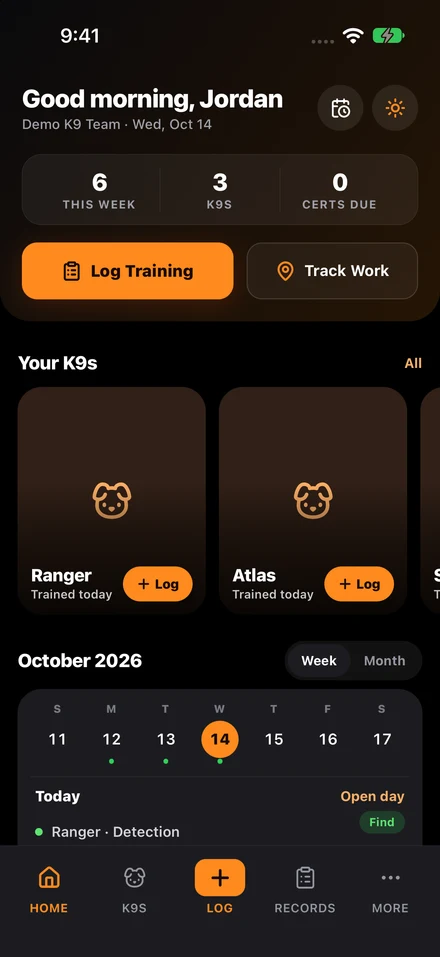
Pennsylvania requires 16 hours of maintenance training a month for police canine teams, and each session needs a record someone can find later.
Pennsylvania keeps basic, maintenance, and evaluation records through the dog’s service plus at least five years.
After two consecutive missed monthly training periods, Pennsylvania requires an evaluation before the team works again.
Paper K9 training logs are quicker to fill in on the spot; digital logs are far easier to review, search, and turn into reports. For most law enforcement programs the answer is a digital record as the official copy, with paper used only for quick field notes during a transition.
That is why many K9 programs start on paper and outgrow it once supervisors need trends, command staff want summaries, or an audit asks for complete records across several dogs and handlers. Digital only wins if it keeps field capture fast.
Checklist
- Keep field capture short enough that handlers complete it every time.
- Require consistent fields before records become reportable.
- Treat the digital record as the official copy during any hybrid transition.
- Export audit packets without rebuilding summaries from handwritten notes.
Paper wins on convenience, not on visibility
A notebook or printed form is easy to use during or right after a session. No connectivity questions, no login friction, and no screen fatigue. For small teams, that simplicity can be enough for a while.
But paper breaks down the moment another person needs to review the data. Supervisors cannot sort logs by certification type, compare results across handlers, or quickly check whether training frequency is slipping. The information exists, but it is trapped in a format that does not support oversight.
Digital logs create consistency at scale
The biggest gain from digital logging is not speed. It is structured repeatability. Each session can require the same core fields, attach the same dog and handler records, and roll directly into dashboards, alerts, and report exports.
That consistency matters more every time a program grows. The same form used by one handler becomes the same form used by the whole unit. That is how leadership gets comparable data instead of a stack of personal note styles.
Audit response is where the difference becomes obvious
When a department or legal team requests records, paper logs create a retrieval project. Someone has to find the relevant binder, verify handwriting, piece together dates, and manually assemble summaries. Digital logs shorten that process because the records are already indexed and connected.
Teams that follow the complete guide to K9 unit management usually end up with a structured digital workflow for this reason. Field notes can stay flexible; what changes is that nobody rebuilds the history from scratch every time someone asks for it.
Hybrid capture can work during transition
Some units are not ready to flip the entire process overnight, and that is fine. A practical transition model is hybrid capture: field notes are recorded quickly, then entered into a structured system before the end of the shift or review cycle. The important part is that the digital record becomes the system of record.
The risk comes when hybrid becomes permanent and nobody knows which version is authoritative. If teams allow paper and digital to diverge, they create the same confusion they were trying to solve.
Choose the workflow your supervisors can keep up with
The decision is less about ideology and more about management load. If the program can still supervise quality, generate reports, and maintain consistent records on paper, the pressure to change may be low. Once those tasks start consuming real time, digital logging becomes the more conservative option because it reduces administrative risk.
The best digital tools keep the speed of a field note while giving command staff a real picture of the unit. Measure any tool against that.
Questions teams ask
Should a K9 team stop using paper immediately?
Not always. A hybrid transition can work if paper is only temporary capture and the structured digital record becomes authoritative before review or reporting.
What is the biggest advantage of digital K9 logs?
The biggest advantage is structured reviewability: supervisors can filter, compare, export, and inspect records without reconstructing history from notebooks.
Sources cited in this guide
Continue reading
Continue with the complete guide to K9 unit management for the broader operating model, or see K9Codex, our K9 training records software for how training records work in the app.