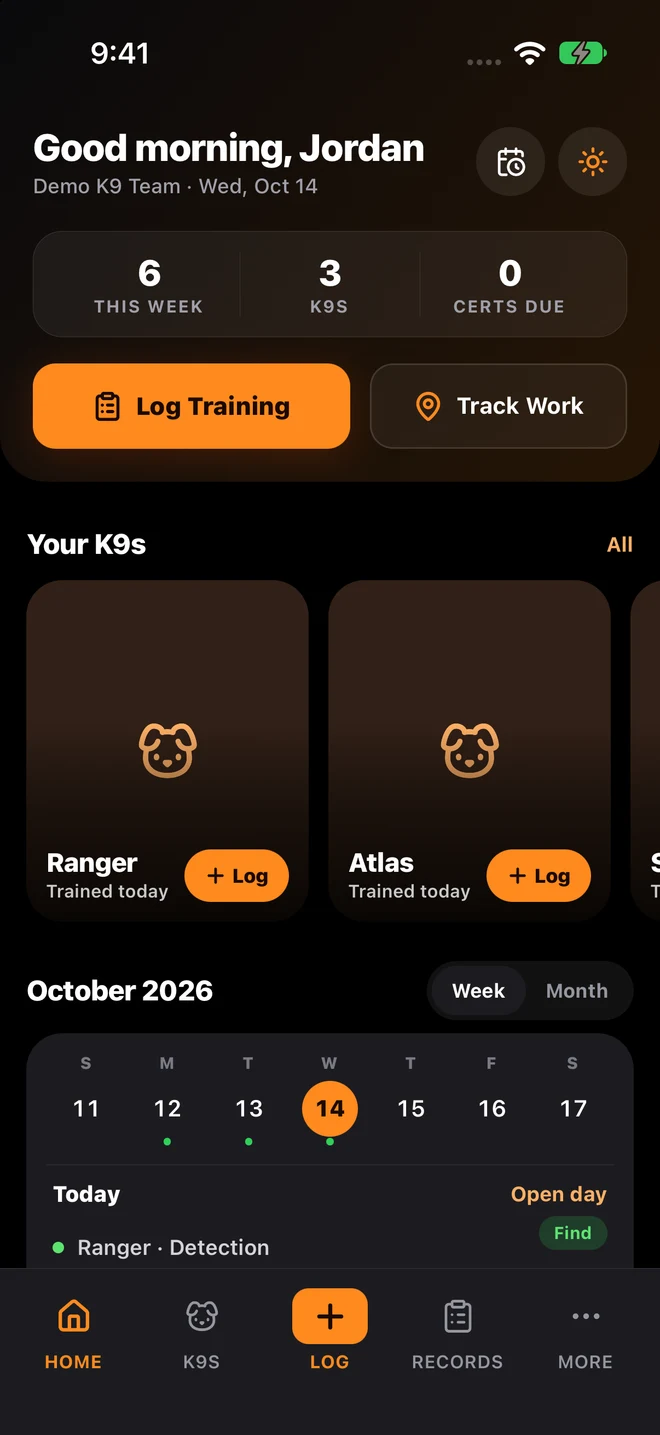
Structured data entry with required fields
Enforce consistent record format across all handlers. Required fields prevent incomplete entries and standardize data for reporting.
Spreadsheets can work for small teams with low training volume, but multi-handler K9 operations reliably outgrow them. Compare practical differences in data control, traceability, reporting speed, GPS integration, and compliance readiness. K9Codex is available on iPhone, web, and desktop for independent handlers and working-dog teams.
Free app download; organization access requires a seat subscription or an existing team invitation. Prices and terms are shown before purchase.
Set up a workspace on the webBefore you move your records
Start with one dog, one training entry, and one report. Check which fields your handlers need, how a supervisor reviews the record, and whether the export fits your existing process. In a walkthrough, we can show the live app using sample data—no operational records are needed to evaluate it.
When multiple handlers share a spreadsheet, version conflicts are inevitable. Someone saves a local copy and overwrites another handler's entries. Cells get accidentally deleted. Formatting changes break formulas. When an auditor or commander asks who changed a record and when, there is no answer — spreadsheets do not reliably track edit history. The operational risk compounds as team size and training volume grow.
K9Codex replaces the shared spreadsheet with a multi-user database where every handler enters records independently through role-scoped access. The audit trail tracks every change with user identity, timestamp, and before/after values. Reports are generated from live data with full traceability. GPS tracking, certification management, and AI record import are features that spreadsheets cannot provide at any scale.
Step 1
Identify where spreadsheet workflows create inconsistency, delay, or risk — version conflicts, missing entries, unverifiable edits.
Step 2
Define non-negotiable needs for data history, certification tracking, reporting quality, and access control.
Step 3
Run a focused migration with one team or unit before expanding across all handlers.
Step 4
Apply a consistent operating model with the same fields, workflows, and reporting formats across all teams.
Deep Dive
Real features from the SYSTALOG K9 training management system that support this workflow.
The transition point typically comes when a team reaches 4-5 handlers or accumulates more than 6-12 months of training data. At that scale, spreadsheet operations start failing in predictable ways: version conflicts between handlers, no audit trail for edits, certification tracking in a separate file, GPS data in yet another app, and report preparation taking hours instead of minutes.
Key Benefits
Focused on practical controls teams use every day.
Enforce consistent record format across all handlers. Required fields prevent incomplete entries and standardize data for reporting.
Track who changed what and when with before/after values. Spreadsheets cannot reliably reconstruct edit history after the fact.
Generate standardized reports from live data in minutes. Spreadsheets require manual assembly and formatting every cycle.
Separate handler entry, trainer review, and admin oversight. Shared spreadsheets blur edit permissions and lack accountability.
Comparison
What changes when your team switches to dedicated K9 software.
Platform Features
Create a web account to set up your workspace, sign in to an existing organization, or ask for a live walkthrough before deciding. Your agency still sets its training and certification requirements.
The portal handles sign up, sign in, and sends people into the right workspace after access is confirmed.